
This problem solving activity has a geometry focus.
Grace’s kitchen floor is square and is fitted by 64 square tiles in a 8 x 8 array.
Grace choses black and white tiles.
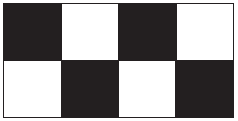
She can have the tiles laid so that they look like a chessboard but she is hoping for something a bit unusual.
The tile man sketches something that has reflective and rotational symmetry.
What does he suggest?
- Create a pattern that involves reflection and rotation.
- Devise and use problem solving strategies to explore situations mathematically (guess and check, make a drawing, use equipment).
- Copymaster of the problem (English)
- Copymaster of the Problem (Māori)
- Paper squares for tiling
The Problem
Grace’s kitchen floor is square and is fitted by 64 square tiles in a 8 x 8 array. Grace choses black and white tiles. She can have the tiles laid so that they look like a chessboard but she is hoping for something a bit unusual. The tile man sketches something that has reflective and rotational symmetry. What does he suggest?
Teaching Sequence
- Introduce the pattern using a chess board (64 squares of alternating colour). Discuss the symmetries of the board.
- Pose the problem.
- Brainstorm for ways to solve the problem – (use equipment, draw, guess and check).
- As the students work on the problem in pairs ask questions that focus their thinking on the symmetries of the pattern.
How have you used reflection?
How have you used rotation? - After the students have completed the floor pattern ask them to record the symmetries that it contains.
- Share patterns – display on wall and discuss.
Extension
Grace decides to have the floor tiles laid like a chessboard after all. While redecorating her kitchen, Grace has some cupboards built. Two of these are placed in the opposite corners of the room and take up a whole tile each. (She needs to use 62 square tiles now.)
The tile man says there's a special on. He has a combined tile that consists of a black tile stuck to a white tile. Can Grace tile her floor with these combination tiles and save herself some money?
Solution
There are a large number of possible answers here. Each one can easily be checked to see that it has the right symmetries.
Solution to the Extension
For the extension, colour the squares like a chessboard. When you remove two opposite squares you remove two squares of the same colour. Thus, you have 30 squares left of one colour and 32 of the other. You can’t cover these with the combination tiles as each combination covers one square of each colour.