
This problem solving activity has a number focus.
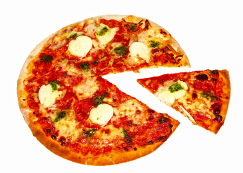 The pizza place has three tables.
The biggest one seats three times as many people as the smallest one.
The middle sized table seats twice as many people as the smallest one.
On Tuesday night three-quarters of the seats were taken.
Then twelve more people arrived.
Unfortunately there were only enough seats for half of them.
How many people can sit at the smallest table?
- Solve problems involving fractions.
- Devise and use problem solving strategies (draw a picture, use equipment, guess and check, be systematic, think).
- Interpret information and results in context.
This problem is a multi-step one that involves fractions and the four arithmetic operations. It requires knowledge of finding a fraction of a whole. It also requires a careful analysis of what is known and what is unknown, and consideration of the best sequence of operations.
The problem can be solved using careful reasoning and by asking, What do I know? and What can I find out from this?
The Problem
The pizza place has three tables. The biggest one seats three times as many people as the smallest one. The middle sized table seats twice as many people as the smallest one.
On Tuesday night three-quarters of the seats were taken. Then twelve more people arrived. Unfortunately there were only enough seats for half of them.
How many people can sit at the smallest table?
Teaching Sequence
- Introduce the problem by posing fraction questions to be solved (mentally, if possible). Ask that the students explain the mental strategies that they used.
I am 3/4 of 16, what number am I?
I am 2/3 of 30, what number am I?
I am 4/6, what other names could I be called? - Pose the problem to the class. Check that they understand what is required by asking volunteers to retell the problem.
- As the students solve the problem ask questions that focus on their understanding of fractions.
How are you solving the problem?
Why are you using those numbers?
Are you convinced that your answer is correct? Why?
Can you convince me that you have the correct answer?
How would you describe what a fraction was to a friend who had forgotten what they were? - Remind the students to record their work so that it can be shared with others.
- Display and discuss solutions.
Extension
Vary: The number of tables, the fractions, or the number of people that can be seated at the smaller table.
Solution
What do we know?
We know that 12 people arrive and half of them are turned away. So 6 are turned away and 6 people can be seated.
Pizza Place is three-quarters full (has one-quarter empty). 6 people is a quarter of a full house. So the full house is 4 times 6 = 24.
Using a guess and check approach:
We could guess that the smallest table seats 3. In that case the next table seats 6 and the biggest table seats 9. Since 3 + 6 + 9 = 18, our guess is a bit low. So guess 5. Then we get 10 and 15 for the other tables. Now 5 + 10 + 15 = 30 and that’s too high. So the smallest table must seat 4. That can be easily checked.
Another approach is to suppose that the smallest table seats 'some'. The next table seats two lots of 'some'. Altogether, this is three lots of some. The biggest table seats three lots of 'some'. That is six lots of 'some' in total. Six lots of some is 24. So some is 4. That’s the number of people that can sit at the smallest table.